Learning locomotion in simulation
This earlier collaborative course project explored forward locomotion for a simulated Half Cheetah agent. It was completed within CIVE 7397: Deep Learning for Engineers at the University of Houston. The demonstrations are simulation screen recordings, not physical robot experiments.
Methodology
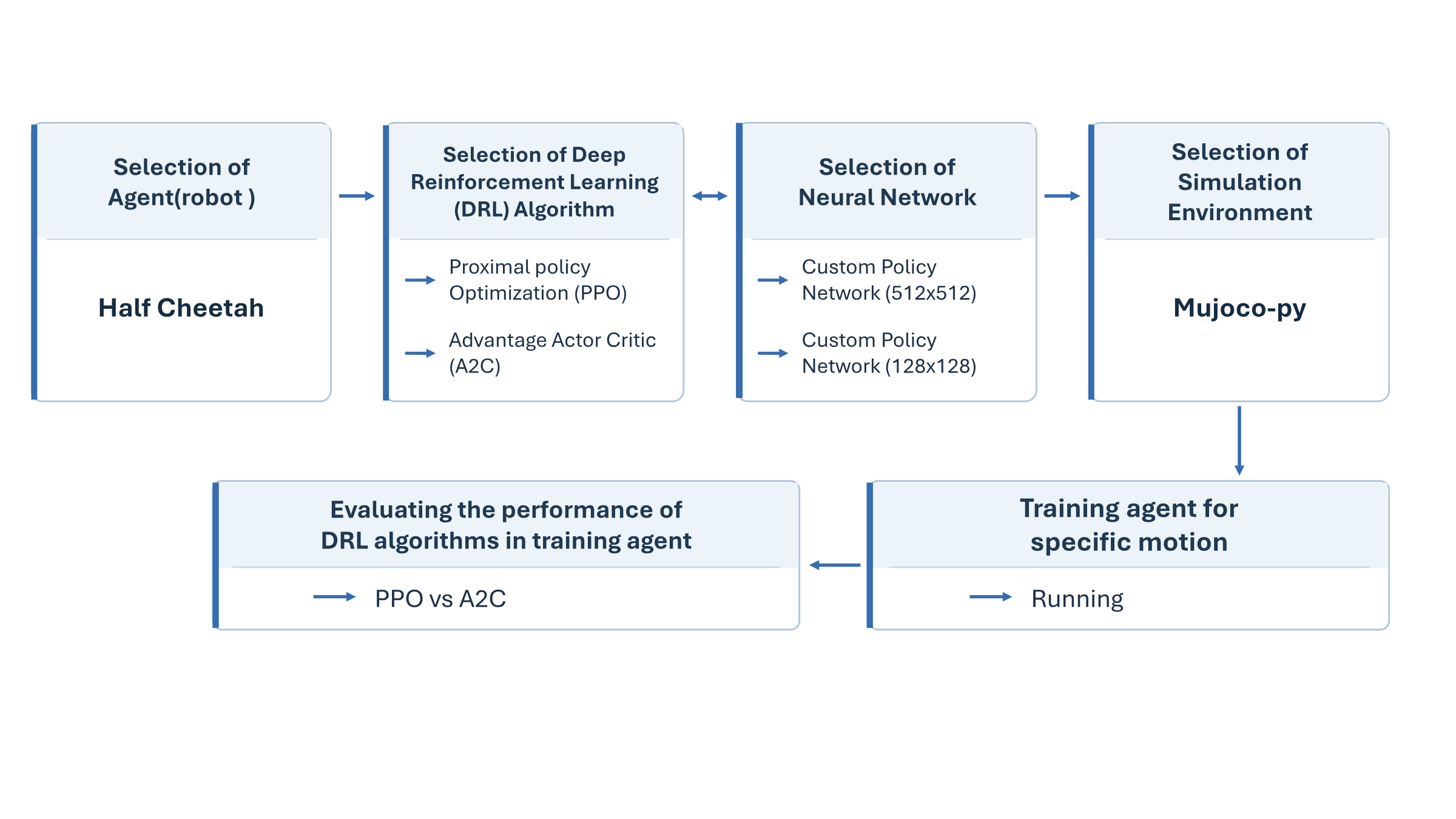
The methodology combines Proximal Policy Optimization (PPO) and Advantage Actor-Critic (A2C), custom policy networks of 512 × 512 and 128 × 128, and the Mujoco-py simulation environment. The task is to train the agent for running and compare the two algorithms.
The demonstrations illustrate simulated locomotion without establishing final reward values, learning curves, success rates, or a performance ranking between the algorithms.
Relationship to my doctoral research
This project studies deep reinforcement learning in simulation. My adaptive-control research uses a hybrid RL–IELM–MPC framework for physical robotic printing. Sensor-Guided Same-Layer Repair is a separate sensor-guided repair framework using a semi-empirical grey-box model and constrained spatial inverse planning; its demonstrated repair pathway does not use reinforcement learning.