Keeping geometry consistent as material changes
Fresh mortar changes its response during printing. A fixed set of process parameters can therefore produce inconsistent layer width and height. This study closes the loop between measured geometry and robot motion to adjust nozzle travel speed and vertical nozzle offset during printing.
How the framework works
- Simulation-trained reinforcement learning (RL) supplies baseline actions using knowledge learned from discrete element method simulations.
- An incremental extreme learning machine (IELM) updates a local forward model from physical printing measurements.
- Model predictive control (MPC) refines the baseline action using predicted geometry, subject to process bounds and smoothness constraints.
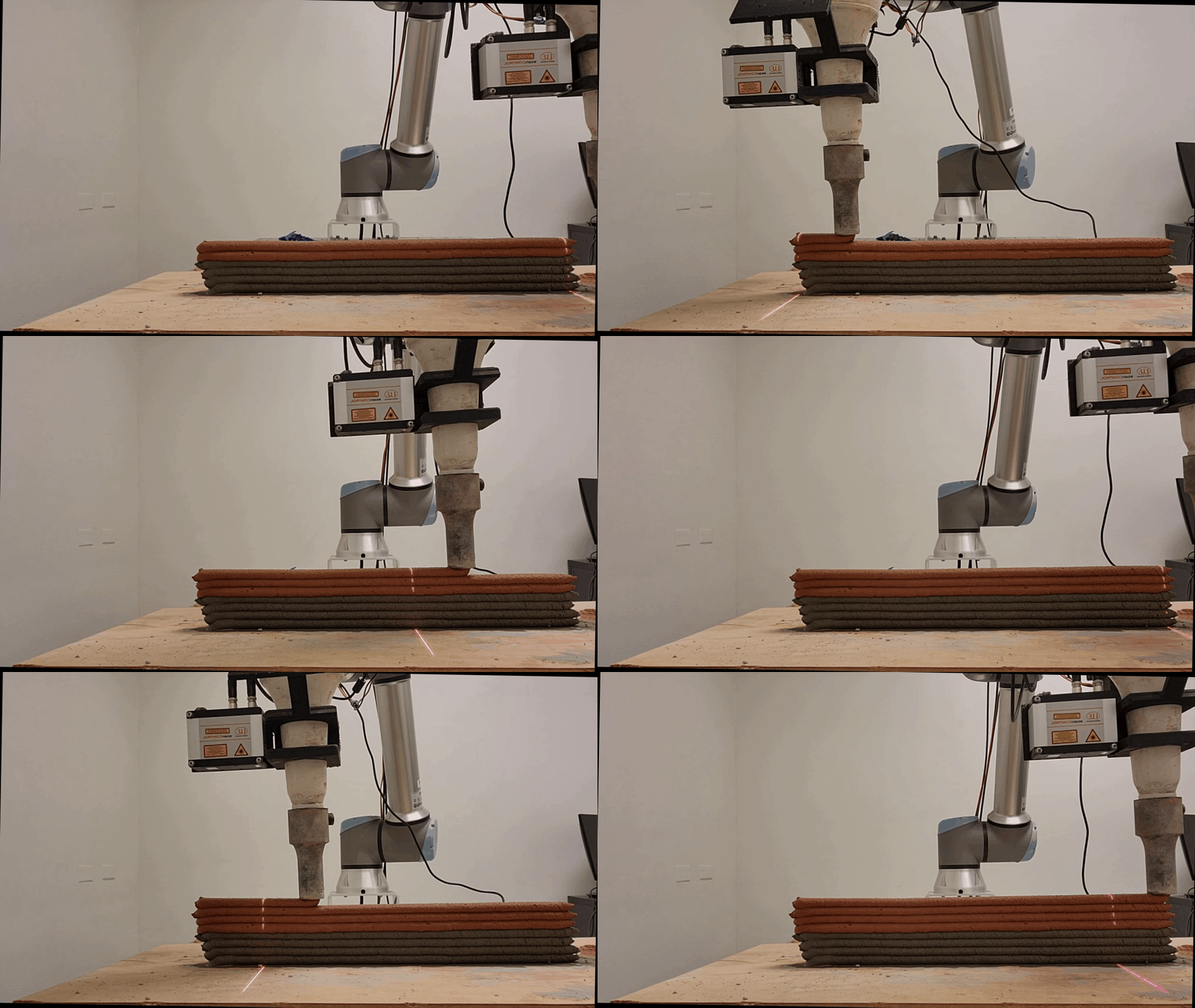
A laser profile scanner measures deposited width and height. Segment-wise updates connect sensing, model adaptation, and physical actuation on a UR10e robot with a custom auger extruder. The extrusion-rate command remains fixed in this study; speed and nozzle offset provide the adaptive actions.
Experimental demonstrations
Original experimental recordings show baseline and adaptive robotic mortar-printing trials. The framework uses laser-scanner measurements to guide geometric control while adjusting robot motion. See the demonstrations below; the formal quantitative evaluation is reported in the journal article.
Publication and recognition
Status: Accepted for Publication (2026).
Real-Time Adaptive Control with Continual Learning for Robotic Construction 3D Printing
Muhammad Arslan, Abdul Wahid Mangi, Vedhus Hoskere (2026).
Journal of Computing in Civil Engineering · American Society of Civil Engineers (ASCE).
DOI: 10.1061/JCCEE5.CPENG-8585
The related EMI talk received Second Place in the Experimental Analysis and Instrumentation Paper Competition at EMI 2026, Boulder, Colorado. Official ASCE winners announcement.