Research motivation and objectives
This project investigates estimating printed layer width from simulation images as a step toward print-quality inspection. It aims to simulate concrete 3D printing in Webots, compare predicted widths with simulation ground truth, and explore a framework for reducing future print failures.
Simulation-based methodology
The workflow connects Webots printing simulation, top-view images of the simulated deposits, and a convolutional neural network (CNN) regressor that predicts layer width. The dataset contains 991 images, with width labels stored in a CSV file.
Results and analysis
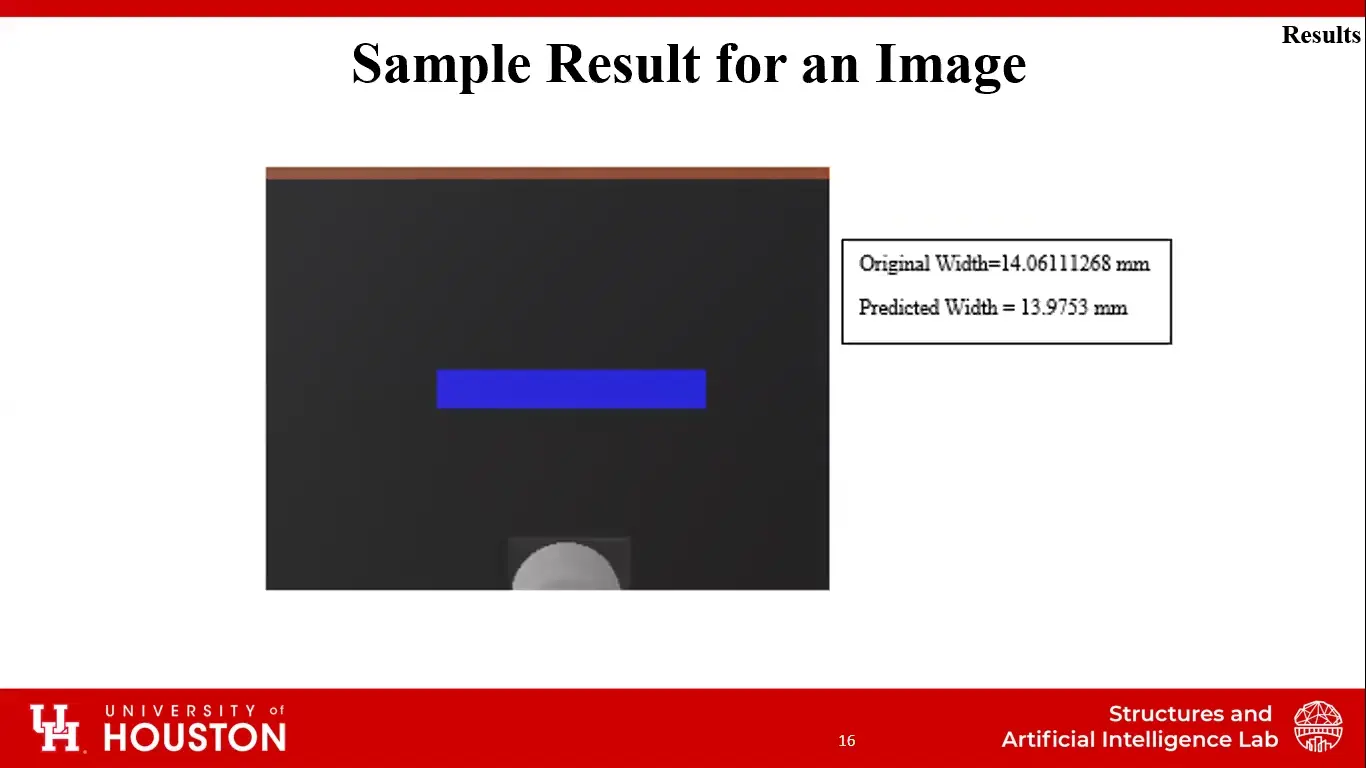
The analysis examines the distribution of layer widths and training results. An individual prediction example compares approximately 14.0611 mm ground-truth width and 13.9753 mm predicted width. This example illustrates a single simulated sample, rather than an overall accuracy measure.
Scope and conclusions
The study demonstrates image-based width prediction on simulation data. Correcting print failures in simulation and implementing the approach on a physical concrete printer are identified as future work. Physical validation and generalization to real printing conditions have not been established.
Presented by Muhammad Arslan, Department of Mechanical Engineering, University of Houston, for CIVE 7397 Structural Health Monitoring.